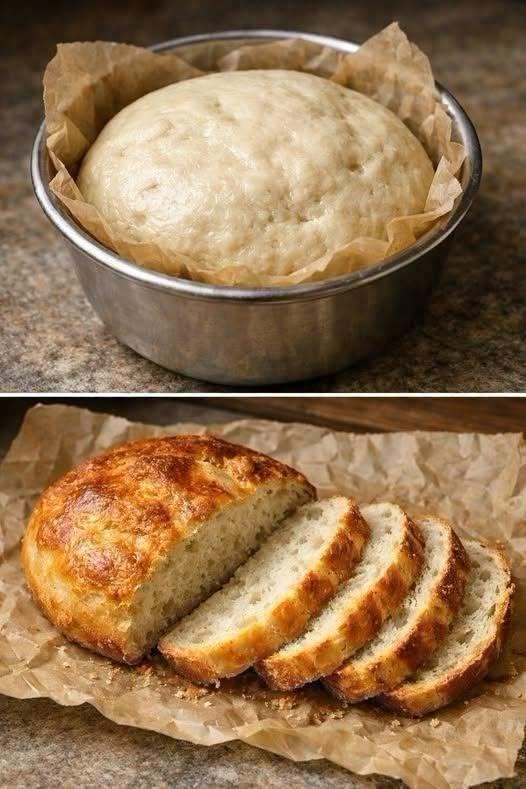
Homemade Rustic Bread
Description
Homemade rustic bread is a simple, crusty loaf with a beautifully chewy interior and an airy, slightly irregular crumb. It requires only a few basic ingredients and little hands-on work. The long resting time develops wonderful flavor while baking in a hot Dutch oven creates a crisp, golden crust.
Recipe Details
- Prep time: 15 minutes
- Resting/proofing: 2–3 hours
- Bake time: 35–45 minutes
- Total time: About 3½–4 hours
- Servings: 8–10 slices
- Yield: 1 medium-large loaf
- Difficulty: Easy
Ingredients
- 3 cups (375 g) all-purpose or bread flour
- 1½ cups (360 ml) warm water
- 1½ teaspoons salt
- 1 teaspoon instant or active dry yeast
- 1 teaspoon honey or sugar, optional
- 1 tablespoon olive oil, optional
Instructions
1. Make the dough
In a large mixing bowl, combine the flour, yeast, and salt. If using honey or sugar, add it as well.
Pour in the warm water and olive oil, if using. Mix with a wooden spoon or your hands until a rough, sticky dough forms.
Don’t worry if the dough looks wet or messy. Rustic bread dough is supposed to be fairly sticky.
2. First rise
Cover the bowl with plastic wrap or a clean kitchen towel.
Let the dough rise at room temperature for 1½–2 hours, or until it has noticeably increased in size and looks bubbly.
3. Shape the loaf
Lightly flour your work surface. Gently transfer the dough onto it.
Fold the dough over itself several times, then shape it into a round or oval loaf. Avoid adding too much flour because this can make the finished bread dense.
Place the dough on parchment paper or a generously floured surface.
4. Second rise
Cover loosely and let the shaped loaf rest for 30–60 minutes.
Meanwhile, place a Dutch oven with its lid in the oven and preheat to 450°F (230°C) for about 30 minutes.
5. Score the bread
Carefully transfer the dough, preferably using the parchment paper, to the hot Dutch oven.
Using a sharp knife or bread lame, make one or two shallow cuts across the top. This allows the bread to expand properly during baking.
6. Bake
Cover with the Dutch oven lid and bake for 25–30 minutes.
Remove the lid and continue baking for another 10–15 minutes, until the crust is deep golden brown and crisp.
7. Cool
Transfer the bread to a wire rack and let it cool for at least 30–45 minutes before slicing.
This cooling period allows the interior to finish setting and helps prevent a gummy crumb.
Recipe Notes
- A Dutch oven gives the best crust because trapped steam helps the bread expand and become beautifully crisp.
- The dough will be sticky. Resist the temptation to add lots of extra flour.
- For more flavor, refrigerate the dough overnight after the first mixing and bake it the next day.
- Bread flour produces a slightly chewier loaf, while all-purpose flour makes a softer rustic bread.
- For an extra-crispy crust, allow the finished loaf to cool completely uncovered.
Helpful Tips
- Use the right water temperature: Warm, not hot. Very hot water can damage the yeast.
- Don’t over-knead: This recipe relies on resting and folding rather than intensive kneading.
- Watch the dough, not just the clock: Rising time varies with room temperature.
- Preheat the Dutch oven: A properly heated pot helps create excellent oven spring.
- Don’t slice immediately: Fresh bread needs time to set.
- For extra flavor: Let the dough rise slowly in the refrigerator overnight.
- For a rustic appearance: Dust the top lightly with flour before scoring.
Variations
- Garlic & Herb: Add 1–2 teaspoons dried herbs and 1 teaspoon garlic powder.
- Rosemary: Add 1 tablespoon chopped fresh rosemary.
- Cheesy: Fold in ½–1 cup shredded cheddar, Parmesan, or Gruyère.
- Whole Wheat: Replace up to 1 cup of all-purpose flour with whole-wheat flour.
- Seeded: Add sunflower, sesame, pumpkin, or flax seeds.
- Olive Bread: Add chopped olives and a little dried oregano.
Approximate Nutritional Information
Per serving, assuming 10 slices and excluding optional olive oil/add-ins:
| Nutrient | Approx. Amount |
|---|---|
| Calories | 150 kcal |
| Carbohydrates | 31 g |
| Protein | 5 g |
| Fat | 1 g |
| Fiber | 1 g |
| Sugar | <1 g |
| Sodium | 350 mg |
Nutrition varies according to flour, salt, slice size, and optional ingredients.
Benefits
- Provides carbohydrates for energy.
- Contains protein from wheat flour.
- Can provide fiber, especially when partially or fully made with whole-wheat flour.
- Homemade means control: You can adjust the salt, flour type, and ingredients according to your preferences.
- No complicated equipment is required: A bowl, spoon, oven, and Dutch oven are enough.
Q&A
Q: Why is my dough so sticky?
A: Rustic bread dough has relatively high hydration, so some stickiness is normal. Lightly flour your hands and work surface rather than adding large amounts of flour.
Q: Can I make this without a Dutch oven?
A: Yes. Bake the loaf on a preheated baking sheet or pizza stone and place a heatproof pan of boiling water in the oven to create steam.
Q: Can I use whole-wheat flour?
A: Yes. For a lighter loaf, start by replacing about 25–30% of the white flour with whole-wheat flour.
Q: Can I prepare the dough the night before?
A: Absolutely. After mixing, cover and refrigerate it overnight. The slow fermentation can produce deeper flavor.
Q: How do I know when the bread is done?
A: It should have a deep golden-brown crust and sound hollow when tapped. If using a thermometer, the center should generally reach about 200–210°F (93–99°C).
Q: How should I store homemade bread?
A: Keep it at room temperature in a paper bag or bread box for about 2–3 days. Avoid refrigerating it because refrigeration can make bread stale faster.
Q: Can I freeze it?
A: Yes. Cool the loaf completely, slice it if desired, wrap it well, and freeze for up to about 3 months. Reheat slices directly from frozen or thaw the whole loaf before warming.
Q: Why did my bread turn out dense?
A: Common causes include insufficient rising, old yeast, adding too much flour, or cutting the bread before it has cooled sufficiently.
Serving Ideas
Enjoy your rustic bread with butter, olive oil and herbs, soup, stew, cheese, eggs, roasted vegetables, or homemade jam. It also makes excellent sandwiches and toast.