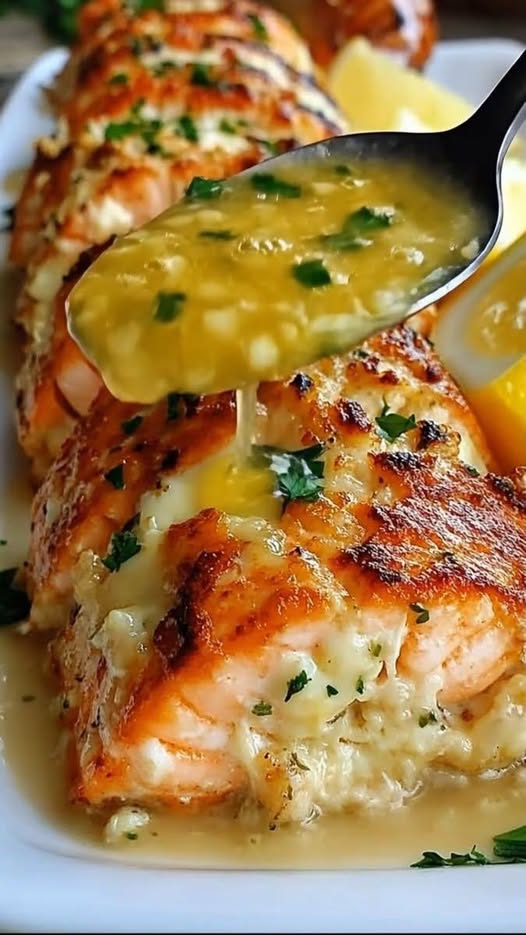
Garlic Butter Salmon with Creamy Lemon Sauce
Description
Garlic Butter Salmon with Creamy Lemon Sauce is a rich, flavorful, and easy dinner featuring tender, pan-seared salmon coated in a buttery garlic sauce and finished with a silky, tangy lemon cream sauce. It comes together quickly and pairs beautifully with rice, mashed potatoes, pasta, or steamed vegetables.
Prep Time: 10 minutes
Cook Time: 20 minutes
Total Time: 30 minutes
Servings: 4
Difficulty: Easy
Ingredients
For the Salmon
- 4 salmon fillets, about 5–6 oz (140–170 g) each
- 1 teaspoon salt
- ½ teaspoon black pepper
- ½ teaspoon paprika
- 1 tablespoon olive oil
- 2 tablespoons unsalted butter
- 5 cloves garlic, minced
- 1 teaspoon Italian seasoning
- 1 tablespoon fresh parsley, chopped
For the Creamy Lemon Sauce
- 2 tablespoons unsalted butter
- 3 cloves garlic, minced
- 1 cup heavy cream
- ½ cup chicken or vegetable broth
- 2 tablespoons freshly squeezed lemon juice
- 1 teaspoon lemon zest
- ¼ cup grated Parmesan cheese
- ½ teaspoon Italian seasoning
- ¼ teaspoon black pepper
- Salt, to taste
- 2 tablespoons fresh parsley, chopped
Instructions
1. Prepare the salmon
Pat the salmon fillets dry with paper towels. Season both sides with salt, black pepper, paprika, and Italian seasoning.
2. Sear the salmon
Heat olive oil in a large skillet over medium-high heat. Place the salmon skin-side down if the fillets have skin.
Cook for about 4–5 minutes without moving them, until nicely browned. Flip and cook for another 3–4 minutes, depending on thickness.
Transfer the salmon to a plate.
3. Make the garlic butter
Reduce the heat to medium. Add 2 tablespoons butter to the same skillet.
Add the minced garlic and cook for about 30–60 seconds, stirring frequently, until fragrant. Avoid burning the garlic.
4. Make the creamy lemon sauce
Add another 2 tablespoons butter. Pour in the chicken or vegetable broth and scrape the browned bits from the bottom of the skillet.
Add the heavy cream, lemon juice, lemon zest, Italian seasoning, and black pepper. Stir well.
Simmer gently for 3–5 minutes, until the sauce begins to thicken.
5. Add Parmesan
Stir in the grated Parmesan cheese. Continue cooking over low heat for about 1–2 minutes, until the cheese melts and the sauce becomes creamy.
Taste and adjust the salt and lemon juice if needed.
6. Return the salmon
Place the salmon back into the skillet and spoon the creamy lemon sauce over the fillets.
Simmer gently for 2–3 minutes, or until the salmon is cooked through. For food safety, salmon should reach about 145°F / 63°C in the thickest part.
7. Garnish and serve
Sprinkle with fresh parsley and a little extra lemon zest. Serve immediately with your favorite side dishes.
Serving Suggestions
This salmon works especially well with:
- Steamed broccoli
- Roasted asparagus
- Green beans
- Garlic mashed potatoes
- White or brown rice
- Buttered pasta
- Quinoa
- Crusty bread for soaking up the sauce
- A simple green salad
Recipe Notes
- Salmon: Fresh or thawed frozen salmon can be used.
- Cream: Heavy cream gives the richest sauce. Half-and-half can be substituted, although the sauce will be lighter.
- Parmesan: Freshly grated Parmesan melts more smoothly than pre-shredded cheese.
- Lemon: Add lemon juice gradually. The amount can be adjusted according to how tangy you like the sauce.
- Thickness: If the sauce becomes too thick, add a splash of broth or cream.
- Skin: Leaving the skin on can help keep the salmon moist. You can remove it before serving if preferred.
- Storage: Refrigerate leftovers in an airtight container for up to 3 days.
- Reheating: Reheat gently over low heat with a splash of cream or broth to prevent the salmon from drying out.
Helpful Tips
1. Dry the salmon first.
Patting the fillets dry helps them develop a better golden-brown crust.
2. Don’t overcrowd the pan.
Use a large skillet so the salmon sears instead of steaming.
3. Don’t burn the garlic.
Garlic can become bitter quickly. Cook it briefly over medium heat.
4. Keep the sauce at a gentle simmer.
Boiling the cream aggressively can cause the sauce to separate.
5. Don’t overcook the salmon.
Remove it from the heat as soon as it reaches the proper internal temperature and flakes easily.
6. Balance the flavors.
If the sauce tastes too rich, add a little more lemon juice. If it tastes too sharp, add a small amount of cream or Parmesan.
Approximate Nutritional Information
Per serving, assuming 4 servings and the ingredients listed above. Values are estimates and vary by salmon size and brands used.
| Nutrient | Approx. Amount |
|---|---|
| Calories | 620 kcal |
| Protein | 42 g |
| Fat | 47 g |
| Saturated Fat | 20 g |
| Carbohydrates | 6 g |
| Fiber | 0.5 g |
| Sugar | 2 g |
| Cholesterol | 160 mg |
| Sodium | 650 mg |
Benefits
- High in protein: Salmon provides substantial high-quality protein to support muscle maintenance and overall nutrition.
- Source of omega-3 fatty acids: Salmon is naturally rich in EPA and DHA omega-3 fats.
- Provides vitamin B12: Salmon is a good dietary source of vitamin B12.
- Contains selenium: Salmon contributes selenium, an essential trace mineral.
- Garlic: Garlic adds flavor while contributing small amounts of various beneficial plant compounds.
- Lemon: Lemon provides vitamin C and brightens the rich cream sauce.
The nutritional benefits depend on the exact ingredients and portions. This recipe is best considered part of a balanced diet rather than a treatment for any health condition.
Frequently Asked Questions
Can I use frozen salmon?
Yes. Thaw it completely and pat it very dry before seasoning and cooking.
Can I make this without heavy cream?
Yes. Half-and-half can be used for a lighter sauce. You can also use evaporated milk, although the texture and flavor will be slightly different.
Can I use milk instead of cream?
You can, but the sauce will be considerably thinner. For better thickness, use a small amount of cornstarch slurry if necessary.
Can I make the sauce without Parmesan?
Absolutely. Parmesan adds savory flavor and helps thicken the sauce, but the recipe will still work without it.
What vegetables go best with creamy lemon salmon?
Broccoli, asparagus, spinach, green beans, zucchini, and peas are excellent choices.
Can I bake the salmon instead?
Yes. Bake seasoned salmon at 400°F (200°C) until cooked through, then prepare the sauce separately and spoon it over the baked salmon.
How do I know when salmon is done?
The thickest part should flake easily with a fork and reach approximately 145°F (63°C) for food safety.
Can I prepare this recipe ahead of time?
You can prepare the sauce and season the salmon ahead of time, but for the best texture, cook the salmon shortly before serving.
How can I make it spicier?
Add ¼–½ teaspoon red pepper flakes or a pinch of cayenne pepper to the sauce.
Can I make this dairy-free?
Yes. Use olive oil or a dairy-free butter alternative and substitute the heavy cream with an unsweetened dairy-free cooking cream. Omit Parmesan or use a suitable dairy-free alternative.
What should I serve with the sauce?
Rice, pasta, mashed potatoes, roasted vegetables, or crusty bread are especially good because they soak up the creamy lemon-garlic sauce.